
Summary
This guide explains the full process of producing creatine gummies, from raw material selection and formulation to cooking, molding, and quality testing. It covers both small-batch DIY methods and scalable manufacturing approaches for brands considering commercial production. Practical insights on dosage accuracy, stability, and regulatory compliance are included to support informed decision-making at every stage.
What Are Creatine Gummies?
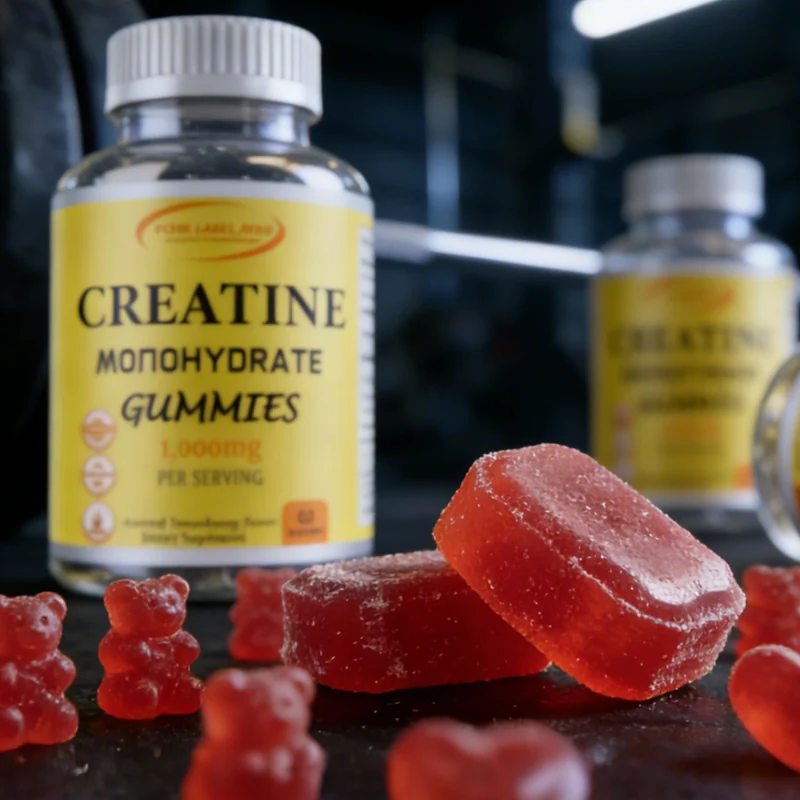
Making your own creatine gummies refers to the process of combining creatine monohydrate powder with gelling agents, sweeteners, and flavoring compounds to produce a chewable, dose-controlled supplement in gummy form. Creatine gummies are an alternative delivery format to traditional powders and capsules, designed to improve convenience and consumer compliance while maintaining the standardized 3–5 gram daily dosing protocol supported by sports nutrition research.
Why Produce Creatine Gummies?
The global creatine supplement market has expanded beyond powder formats as consumers seek portable, taste-masked, and pre-dosed options. Gummies address common pain points associated with powdered creatine: gritty texture, inaccurate scooping, and the need for a mixing vessel. For brands, gummy formats command higher retail margins and appeal to broader demographics, including casual fitness consumers who may not tolerate raw powder.
Step-by-Step Process to Make Creatine Gummies
Step 1: Select the Creatine Form
Creatine monohydrate is the most researched and cost-effective form, with over 500 published studies confirming its efficacy and safety. Micronized creatine monohydrate (particle size below 200 microns) disperses more evenly in gummy matrices and reduces grittiness in the final texture. Avoid creatine HCL or buffered creatine for gummy production, as their higher solubility can interfere with gelling agent performance during cooking.
Step 2: Choose the Gelling Base
Pectin and gelatin are the two primary gelling agents used in supplement gummy production. Pectin is plant-derived and suitable for vegan and halal markets, but requires precise pH control (3.0–3.5) and a high sugar or polyol content to set properly. Gelatin provides a firmer, more elastic texture and is more forgiving during processing, but is animal-derived. A hybrid pectin-gelatin blend is common in commercial creatine gummies to balance texture, dietary compliance, and production stability.
Step 3: Prepare the Syrup Base
Combine water, a bulk sweetener (glucose syrup, tapioca syrup, or isomalt for sugar-free versions), and the gelling agent in a stainless steel or non-reactive pot. Heat the mixture to 75–85 degrees Celsius while stirring continuously. The target Brix level for the cooked syrup is typically 75–82 degrees, depending on the desired final moisture content. Inadequate cooking results in sticky, deformable gummies; overcooking causes excessive hardness and potential degradation of the creatine.
Step 4: Incorporate Creatine and Actives
Remove the syrup from direct heat and reduce the temperature below 65 degrees Celsius before adding creatine monohydrate. Creatine begins to degrade into creatinine at sustained temperatures above 60 degrees Celsius, so timing and temperature control at this stage are critical. Add the creatine gradually while mixing to prevent clumping. If the formulation includes additional ingredients such as vitamin B6, electrolytes, or flavor oils, add them at this stage using a high-shear mixer to ensure uniform distribution.
Step 5: Mold and Set
Pour the mixed slurry into silicone or starch molds using a depositor for accuracy. For small-batch production, manual pouring into silicone trays is sufficient. For commercial runs, a servo-driven depositor ensures consistent weight per piece, which directly impacts dosage accuracy. Allow the gummies to set at controlled room temperature (20–25 degrees Celsius) and humidity (below 45% RH) for 30–60 minutes for gelatin-based products, or 2–4 hours for pectin-based products.
Step 6: Demold, Dry, and Coat
After setting, demold the gummies and transfer them to a drying room or tunnel. The target final moisture content is 15–20% for gelatin gummies and 18–22% for pectin gummies. Drying typically takes 12–36 hours depending on size, thickness, and ambient conditions. Once dried, apply an anti-caking coating such as carnauba wax, beeswax, or oil-based sprays to prevent sticking during packaging.
Step 7: Package and Label
Package the finished gummies in moisture-barrier pouches or bottles with desiccant packs. Creatine gummies are hygroscopic and will absorb ambient moisture, leading to deformation and texture degradation. Labeling must include the exact creatine content per serving, batch number, manufacturing date, and applicable regulatory statements (FDA disclaimer in the U.S., FSSAI compliance in India, etc.).
Technical Parameters for Creatine Gummy Production
| Parameter | Specification | Notes |
|---|---|---|
| Creatine form | Micronized creatine monohydrate | Particle size below 200 microns for even dispersion |
| Dosage per gummy | 0.5–1 gram | 3–5 gummies per serving to reach 3–5 g daily dose |
| Cooking temperature | 75–85 degrees Celsius | Creatine added after cooling below 65 degrees Celsius |
| Brix level (cooked syrup) | 75–82 degrees | Determines final texture and moisture content |
| Gelling agent options | Gelatin, pectin, or hybrid blend | Pectin requires pH 3.0–3.5 to set correctly |
| Final moisture content | 15–22% | Gelatin: 15–20%; Pectin: 18–22% |
| Drying time | 12–36 hours | Depends on gummy size, thickness, and humidity |
| Shelf life | 12–24 months | Requires moisture-barrier packaging and desiccant |
| Weight variance per piece | Within plus or minus 3% | Critical for dosage accuracy and label compliance |
| Creatinine limit (degradation marker) | Below 50 ppm | Tested via HPLC to confirm thermal stability |
Practical Insights for Production and Quality Control
Production Consistency
Dosage uniformity is the single most critical quality metric for creatine gummies. Unlike powders where users self-measure, gummies deliver a fixed dose per piece. Weight variance must be controlled within plus or minus 3% per piece, which requires either precision manual depositors or automated servo-driven equipment for commercial volumes. Inconsistent piece weight directly translates to under-dosing or over-dosing, both of which are regulatory and liability risks.
Thermal Degradation Management
Creatine monohydrate converts to creatinine when exposed to sustained heat above 60 degrees Celsius. The production workflow must separate the high-temperature cooking phase from the creatine incorporation phase. Post-production testing via HPLC should verify that creatinine levels remain below 50 ppm in the finished product. Brands that skip this testing step risk selling a degraded product with reduced efficacy.
Moisture and Shelf Stability
Creatine gummies are highly hygroscopic. Final moisture content, packaging material selection, and storage conditions collectively determine shelf life. A finished product with moisture above 22% will exhibit sticking, deformation, and potential microbial growth within weeks. Moisture-barrier pouches with aluminum foil layers, combined with food-grade desiccant packs, are the minimum standard for 12-month shelf stability at ambient conditions.
Scalability Considerations
Transitioning from kitchen-scale to commercial-scale production introduces challenges in heat distribution, mixing homogeneity, and drying consistency. Batch cookers larger than 50 liters require jacketed vessels with controlled heating to avoid hot spots that degrade the gelling agent. Starch molding, the industry standard for high-volume gummy production, offers superior shape definition and faster demolding compared to silicone tray methods but requires significant capital investment and starch handling infrastructure.
Regulatory Compliance
In the United States, creatine gummies are regulated as dietary supplements under DSHEA. Facilities must be cGMP-compliant, and each batch requires a certificate of analysis (COA) confirming identity, purity, potency, and absence of contaminants (heavy metals, microbes, pesticides). In the European Union, creatine is classified as a novel food ingredient with specific authorized forms and maximum daily intake levels. Brands exporting to multiple markets must map regulatory requirements by country before committing to production.
B2B Decision Guide: Outsourcing vs. In-House Production
When to Partner with a Manufacturer
Brands without existing gummy production infrastructure should partner with an established creatine gummies manufacturer to avoid the capital expenditure of cleanroom construction, equipment procurement, and regulatory setup. Contract manufacturing eliminates the need to hire specialized food scientists, quality assurance personnel, and production operators. The typical timeline from formula finalization to finished goods delivery is 6–10 weeks with a contract manufacturer, compared to 6–12 months for building in-house capability.
When to Build In-House
In-house production becomes economically viable at sustained annual volumes above 2 million units, where the per-unit cost savings from vertical integration offset fixed overhead. Companies with existing gummy product lines can absorb creatine gummy production with marginal incremental cost by leveraging existing cookers, mold lines, and drying tunnels. However, creatine-specific quality testing (creatinine HPLC analysis) must still be established regardless of production location.
Private Label as a Market Entry Strategy
For brands seeking rapid market entry with minimal development risk, private label creatine gummies offer pre-formulated, pre-tested products that can be customized with brand-specific packaging and labeling. Private label programs typically require lower minimum order quantities (5,000–10,000 units) compared to full custom formulation (50,000+ units). The trade-off is limited differentiation in formula, flavor, and dosage configuration, which may become a competitive disadvantage in saturated markets.
Key Selection Criteria for a Manufacturing Partner
- cGMP-certified facility with ISO 22000 or FSSC 22000 accreditation
- Proven experience in creatine-containing gummy production with verifiable batch records
- In-house HPLC testing capability for creatine potency and creatinine degradation
- Flexible MOQ structure supporting both trial runs and volume production
- End-to-end capability from formulation through packaging and regulatory documentation
- Ability to produce vegan/halal/kosher certified variants using pectin-based formulations
Conclusion
Producing creatine gummies requires precise control over formulation chemistry, thermal processing, and moisture management to deliver a stable, accurately dosed product. The critical success factors are adding creatine below 65 degrees Celsius to prevent degradation, maintaining piece weight within plus or minus 3% for dosage consistency, and using moisture-barrier packaging to ensure shelf stability. For most brands, partnering with an experienced contract manufacturer provides the fastest, lowest-risk path to market, while in-house production is justified only at high sustained volumes. Regardless of the production model, rigorous batch testing for creatine potency and creatinine levels is non-negotiable for product integrity and regulatory compliance.
FAQ
Can you add creatine directly to boiling syrup?
No. Creatine monohydrate degrades into creatinine at sustained temperatures above 60 degrees Celsius. The syrup must be cooked first, then cooled below 65 degrees Celsius before creatine is incorporated under gentle mixing.
How many creatine gummies equal one standard dose?
A standard daily creatine dose is 3–5 grams. Most commercially available creatine gummies contain 0.5–1 gram of creatine per piece, requiring 3–5 gummies per serving to reach the effective dose.
Do creatine gummies work as well as powder?
When manufactured correctly with verified potency and minimal creatinine degradation, creatine gummies deliver the same effective dose as powder. The delivery format does not alter creatine’s mechanism of action in the body.
What is the shelf life of creatine gummies?
Properly manufactured and packaged creatine gummies typically have a shelf life of 12–24 months when stored in moisture-barrier packaging with desiccant at temperatures below 25 degrees Celsius.
Can creatine gummies be made vegan?
Yes. Pectin-based formulations replace gelatin as the gelling agent, resulting in a fully plant-based product. Pectin gummies require stricter pH control (3.0–3.5) during production compared to gelatin-based alternatives.
Is HPLC testing necessary for creatine gummies?
Yes. HPLC testing is the standard method for verifying creatine potency and quantifying creatinine levels in the finished product. Without this test, there is no way to confirm that thermal processing did not degrade the active ingredient below effective levels.
About Shenzhen Gothink Biotech Co., Ltd.
Shenzhen Gothink Biotech Co., Ltd. is a leading nutrition supplement supplier and dietary supplement manufacturer based in China, providing comprehensive OEM, ODM, CMO, and CDMO services. The company delivers end-to-end turnkey solutions spanning product consultation, formulation development, custom design, manufacturing, packaging, and marketing support for global health brands.
The company’s R&D leadership includes a co-founder and chief scientific advisor with postdoctoral research experience at the California Institute of Technology, Emory University, and Ohio State University. Their expertise in plant extraction and biomanufacturing positions Gothink’s formulation and quality assurance capabilities at the forefront of the dietary supplement industry.
Gothink holds multiple international certifications including ISO 9001, ISO 22000, HACCP, FDA, HALAL, GMP, KOSHER, BRC, FSSC 22000, PJPH, and Vegan. The production facility features a 100,000-class cleanroom with a daily output of 16 tons and an annual capacity of 5,000 tons, supported by a 10,000-class pharmaceutical-grade R&D laboratory. The R&D team conducts formulation research on approximately 2,000 new products annually.
Core manufacturing capabilities cover gummy, capsule, tablet, powder, liquid, and drop supplement production. Gummy contract manufacturing services utilize natural gelling agents including pectin and carrageenan, with full customization from formula development and flavor design through molding and packaging. The company supports brands at all stages, from small trial runs to full-scale bulk production and wholesale operations, with flexible minimum order quantities adapted to the needs of online sellers, retailers, established brands, and startups.
For businesses seeking to create creatine gummies at scale, Gothink provides the infrastructure, scientific expertise, and regulatory compliance framework necessary to bring products from concept to market efficiently and reliably.