
Understanding the distinction between private label and white label gummy production models is essential for brands entering the dietary supplement market. This article provides a structured comparison of both approaches, covering formulation control, cost structures, compliance requirements, and scalability to help B2B buyers make informed sourcing decisions.
What Are Private Label and White Label Gummies?
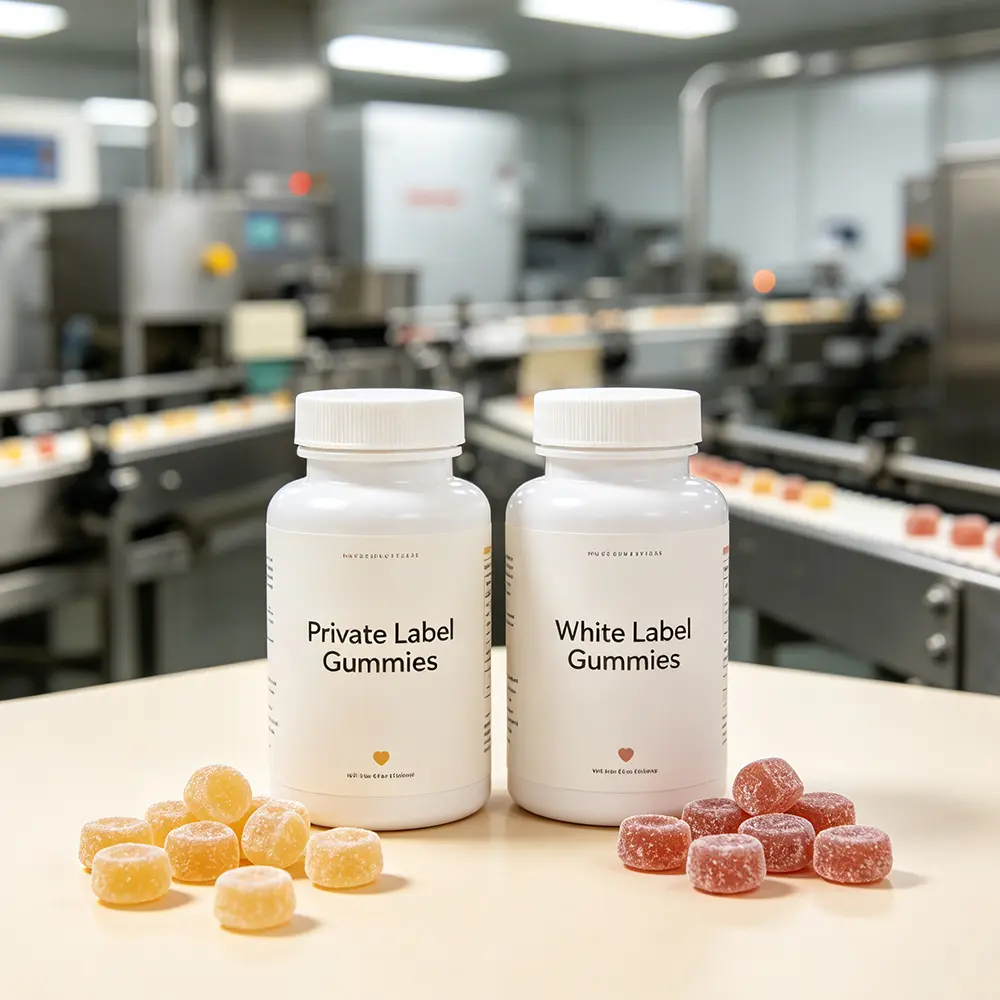
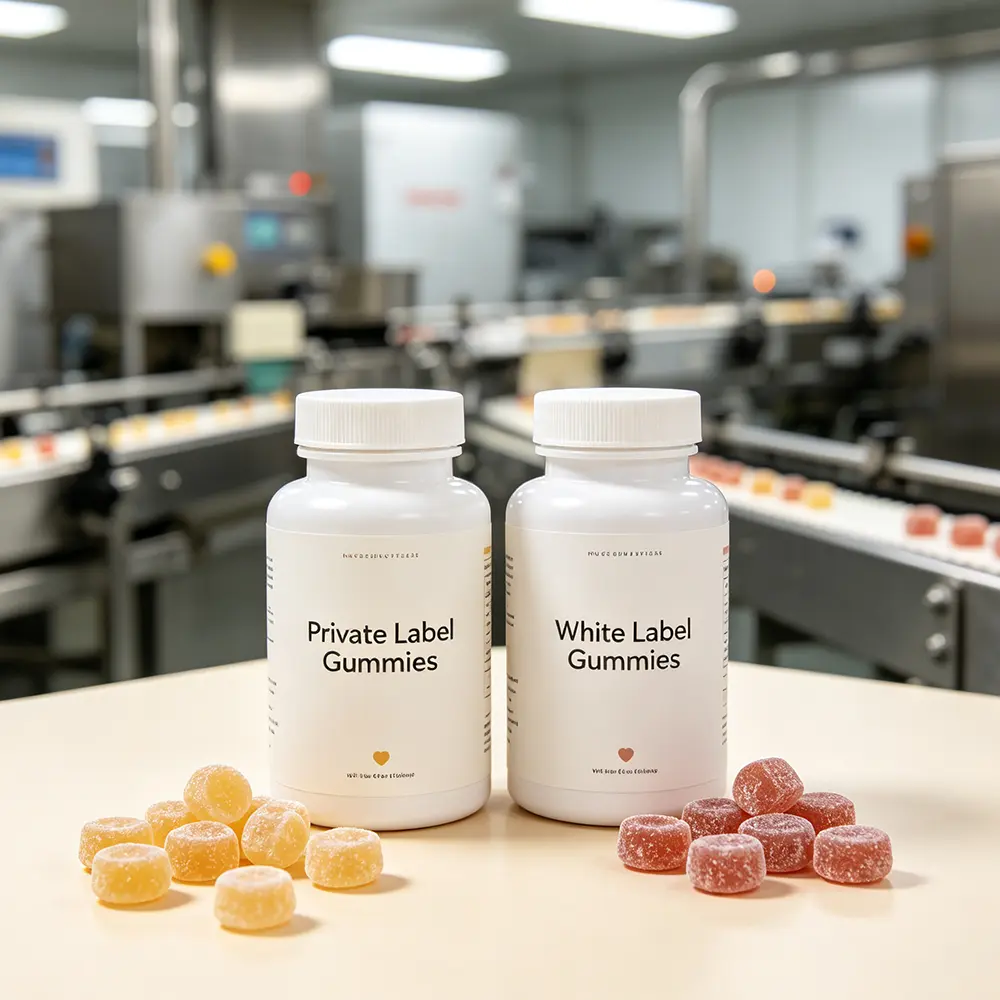
Private label gummies vs white label gummies refers to two distinct manufacturing models used by brands to bring gummy supplement products to market without owning production facilities. In a white label model, a manufacturer produces pre-formulated gummy products that multiple brands can purchase and sell under their own brand name with minimal customization. In a private label model, the brand works directly with a manufacturer to develop a custom formulation, select specific ingredients, design unique shapes or flavors, and create a product that is exclusive to that brand.
Both models allow brands to leverage external manufacturing capacity, but they differ significantly in the degree of control, customization, time-to-market, and upfront investment required.
Core Differences Across Key Dimensions
Formulation Control
White label gummies use ready-made formulations developed by the manufacturer. Brands cannot alter the ingredient list, dosage levels, or nutritional profile. Private label gummies, by contrast, are built from the ground up based on the brand’s specifications, allowing full control over active ingredients, excipients, concentrations, and functional claims.
Brand Exclusivity
Products produced under a white label agreement are typically available to any brand that purchases them. The same gummy formula may appear on shelves under dozens of different brand names. Private label formulations are exclusive to the commissioning brand, reducing direct product-level competition in the market.
Time to Market
White label products can be launched in as few as 2 to 4 weeks since the formulation, testing, and production processes are already completed. Private label gummies generally require 8 to 16 weeks to account for formulation development, stability testing, prototype iterations, and regulatory review.
Cost Structure
White label models carry lower minimum order quantities (MOQs) and lower per-unit costs at small volumes because development costs are distributed across multiple buyers. Private label production requires upfront investment in R&D, stability testing, and tooling, resulting in higher initial costs but potentially better margins at scale.
Technical Parameter Comparison
| Parameter | White Label Gummies | Private Label Gummies |
|---|---|---|
| Formulation Customization | None (pre-set formula) | Full (custom formula) |
| Brand Exclusivity | No | Yes |
| Typical Lead Time | 2–4 weeks | 8–16 weeks |
| Minimum Order Quantity | 1,000–5,000 units | 10,000–50,000 units |
| Upfront R&D Cost | None | $3,000–$15,000+ |
| Flavor Customization | Limited to available options | Fully customizable |
| Shape and Mold Options | Standard molds only | Custom mold available |
| Regulatory Documentation | Shared dossier | Bespoke dossier |
| Per-Unit Cost at Scale | Moderate | Lower (higher volume) |
| Suitable For | Startups, test markets | Established brands, differentiation |
Practical Insights for Gummy Production
Production Considerations
Selecting the right Gummy Factory is a foundational decision that affects every downstream aspect of product development. A qualified gummy factory should operate with pharmaceutical-grade cleanroom environments, such as 100,000-class facilities, and maintain daily output capacities sufficient to support both trial runs and large-scale commercial orders. Brands should verify that the factory uses validated depositing or starch molding production lines, as these directly impact gummy consistency, weight accuracy, and surface finish.
When working with a gummy factory on private label gummies, it is important to confirm whether the facility can handle specialized gelling agents such as pectin or carrageenan for vegan formulations, as not all production lines are equipped for these alternatives to gelatin.
Quality Control and Assurance
Quality control in gummy manufacturing spans raw material verification, in-process monitoring, and finished product testing. A reputable manufacturer should conduct testing for active ingredient potency, heavy metals, microbial contamination, and physical properties such as texture, color consistency, and weight variation. Certifications including ISO 9001, ISO 22000, HACCP, GMP, and FSSC 22000 serve as objective indicators of a manufacturer’s quality management maturity.
For private label gummies, stability testing under accelerated conditions (typically 40°C and 75% relative humidity) is mandatory to validate shelf-life claims. White label products may already have stability data available, but brands should request the full stability report rather than accepting a summary claim.
Scalability
Brands planning for growth should evaluate whether their chosen manufacturing partner can scale from initial MOQs to full commercial volumes without compromising quality or lead times. A facility with an annual production capacity of 5,000 tons and daily output of 16 tons, for example, can support a brand’s progression from market entry to national distribution without requiring a manufacturer transition.
Regulatory Compliance
Gummy supplements must comply with the regulatory requirements of their target market. In the United States, this means adherence to FDA dietary supplement regulations under 21 CFR Part 111, including current Good Manufacturing Practice (cGMP) requirements. For the European market, compliance with EU Food Supplements Directive 2002/46/EC is required. Brands exporting to multiple regions should work with manufacturers that hold certifications recognized across jurisdictions, such as HALAL, KOSHER, BRC, and Vegan certifications.
White label gummies typically come with pre-existing regulatory dossiers, which simplifies compliance but limits the brand’s ability to make unique claims. Private label products require bespoke regulatory documentation, which takes longer but provides full claim substantiation control.
B2B Decision Guide: Choosing the Right Model
The choice between white label and private label gummies should be driven by a structured assessment of the following factors:
Brand Strategy
If the brand’s competitive strategy relies on product uniqueness, proprietary formulations, or differentiated functional claims, private label is the appropriate model. If the brand competes primarily on marketing, distribution, or pricing within a commodity category, white label may provide sufficient product foundation.
Budget and Timeline Constraints
Brands with limited initial capital or tight launch timelines benefit from the white label model’s lower entry barriers. Private label requires both higher upfront investment and longer development cycles, but it reduces the risk of market commoditization over the product lifecycle.
Market Maturity
In emerging markets or new product categories where consumer preferences are not yet established, white label products allow rapid market testing with minimal risk. In mature, competitive markets where shelf differentiation is critical, private label gummies provide the formulation exclusivity needed to maintain margin protection.
Long-Term Margin Analysis
While white label products offer lower per-unit costs at small volumes, private label gummies typically achieve better unit economics at scale due to optimized formulations, reduced intermediary markups, and stronger retail pricing power driven by product exclusivity. B2B buyers should model total cost of ownership over a 24 to 36 month horizon rather than comparing only initial per-unit pricing.
Supplier Capability Assessment
When evaluating potential manufacturing partners, B2B buyers should verify: (1) cleanroom certification level and production capacity, (2) in-house R&D capabilities including access to pharmaceutical-grade laboratories, (3) breadth of OEM/ODM/CMO/CDMO service offerings, (4) existing regulatory certifications across target markets, and (5) willingness to support both small trial orders and large-scale production runs.
Conclusion
White label and private label gummies serve different strategic purposes in the dietary supplement industry. White label gummies offer speed, lower entry costs, and reduced complexity, making them suitable for market testing, new brand launches, and volume-driven distribution strategies. Private label gummies deliver formulation exclusivity, full customization, and stronger long-term competitive positioning, at the cost of higher upfront investment and longer development timelines. The optimal choice depends on the brand’s market position, budget, timeline, and growth objectives. In both cases, selecting a qualified manufacturer with verifiable certifications, robust quality systems, and scalable production capacity is the single most important determinant of product success.
Frequently Asked Questions
What is the main difference between white label and private label gummies?
White label gummies use pre-made formulations sold to multiple brands, while private label gummies are custom-formulated products exclusive to a single brand.
Which model has a lower minimum order quantity?
White label gummies typically have lower MOQs, ranging from 1,000 to 5,000 units, compared to 10,000 to 50,000 units for private label production.
Can white label gummies be customized?
Customization is limited to packaging and branding. The formulation, flavor, shape, and ingredient profile cannot be altered in a standard white label arrangement.
How long does private label gummy development take?
Private label gummy development typically requires 8 to 16 weeks, including formulation, prototype testing, stability evaluation, and production setup.
Is private label more cost-effective than white label at high volumes?
Yes. Private label gummies generally achieve lower per-unit costs at scale due to optimized formulations and the elimination of shared development overhead.
What certifications should a gummy manufacturer have?
Key certifications include ISO 9001, ISO 22000, HACCP, GMP, FDA registration, HALAL, KOSHER, BRC, and FSSC 22000, depending on the target market.
This article is provided by Gothink Biology, a globally recognized dietary supplement manufacturer, offering comprehensive OEM, ODM, CMO, and CDMO services. Shenzhen Gothink Biotech Co., Ltd. is one of China’s leading Nutrition Supplement Suppliers & Dietary Supplement Manufacturer, providing end-to-end turnkey solutions covering product consultation, formulation development, custom design, manufacturing, packaging, and marketing support. With a strong focus on quality and innovation, we help global health brands efficiently and reliably transform ideas into market-ready products.
Our GMP-certified facility features a 100,000-class cleanroom, with a daily output of 16 tons and an annual capacity of 5,000 tons—ensuring fast, reliable delivery. Our team is led by postdoctoral researchers from U.S. universities and is supported by a 10,000-class pharmaceutical-grade laboratory, enabling precise and innovative formulations. We conduct formulation research on 2,000 new products annually. From small trial runs to full-scale production, we provide adaptable solutions for online sellers, retailers, brands, and startups.