
Executive Summary
Learning how to Make Gummies that deliver on label claims through 24 months of shelf life requires more than a confectionery recipe — it demands formulation engineering, process control, and stability science. The global gummy nutraceutical market reached USD 24.39 billion in 2025 and is projected to hit USD 47.80 billion by 2030 (CAGR 14.4%), yet an estimated 30–40% of gummy launches fail their first stability study because brands underestimate the heat-and-moisture challenge inherent to the format. This guide provides a complete technical framework — from gelling system selection to supplier qualification — designed to help brand owners, product developers, and procurement teams make informed decisions and avoid costly formulation failures.
What Is Gummy Vitamin Manufacturing?
Gummy vitamin manufacturing is the industrial process of producing chewable, gel-based dietary supplements by combining a gelling agent matrix (gelatin or pectin), a sweetener system, and bioactive ingredients (vitamins, minerals, botanicals, or functional compounds) through controlled cooking, deposition, curing, and coating. Unlike tablets or capsules — which are dry-powder compression or encapsulation processes — gummy production operates in a high-moisture, high-temperature environment that creates unique stability and bioavailability challenges. The format accounts for over 24% of the global nutraceutical market, driven by consumer preference for palatable, pill-free delivery systems.
Why Gummies Are Different from Tablets and Capsules
Tablets and capsules are dry-powder systems. Gummies are wet, sugar-based gels with water activity typically between 0.55 and 0.75. That moisture, combined with the 60–105°C processing temperatures required to cook and deposit the syrup, creates an environment that actively degrades many vitamins and minerals. Water-soluble vitamins like vitamin C and B-complex are particularly vulnerable: unencapsulated vitamin C in gummies retained only 79% of its potency during accelerated stability testing over ten weeks, while encapsulated versions retained 92% (Journal of Dietary Supplements, 2024).
This isn’t a problem you can solve with a better flavor system. It requires formulation decisions made at the ingredient level, process controls enforced batch by batch, and stability data that proves your product works at expiry — not just at the day of manufacture. For brand owners evaluating their options, understanding this fundamental difference is the first filter in deciding whether the gummy format is right for your active ingredient portfolio.
Step 1: Formulation — Selecting the Right Actives and Gelling System
Every gummy formula starts with three structural decisions: the gelling agent, the sweetener system, and the active ingredient forms. These three choices determine 80% of your product’s final cost, stability profile, and market positioning.
Gelling agent selection sets the foundation. Gelatin (animal-derived) deposits at 60–70°C, offers elastic chew, and tolerates some process variation because it can be remelted and reset. Pectin (plant-derived) deposits at 95–105°C, cannot be remelted once set, and requires tight pH control (typically 3.2–3.6). Pectin gummies are heat-stable at room temperature and fit vegan, Halal, and Kosher lines. Gelatin gummies melt in warm conditions — a problem for e-commerce fulfillment and tropical markets. The choice affects your label, your supply chain, and your manufacturing tolerances.
Active ingredient forms determine whether your vitamins survive the process. Heat-labile nutrients like vitamin C, B vitamins, probiotics, and certain botanical extracts require protection strategies: microencapsulation, liposomal delivery, or post-deposition coating. Mineral forms also matter — oxide forms are cheap but poorly absorbed (e.g., magnesium oxide has ~4% bioavailability), while citrate, bisglycinate, and picolinate forms offer 2–4x better bioavailability but at 30–60% higher cost. Your manufacturing partner should be able to recommend active forms based on their processing parameters, not just what’s cheapest.
Sweetener systems impact texture, stability, and label positioning. Sugar-based systems are easier to process and mask flavors effectively. Sugar-free systems using allulose, erythritol, or isomalt require different pectin chemistry and often produce softer texture. Sugar-free gummies command 20–35% higher retail prices but add formulation complexity and may require additional stability testing due to altered water activity profiles.
Step 2: Process Walkthrough — From Syrup Kitchen to Finished Bottle
Gummy Vitamin Manufacturing follows a six-stage process. Each stage has critical control points that determine final product quality, and mismanagement at any stage can cascade into stability failures, texture defects, or potency shortfalls.
Stage 1: Base syrup cooking. Gelling agent (gelatin or pectin), sweeteners, water, and syrup are cooked into a homogeneous mass. Target concentration typically runs 75–82°Brix. Pectin requires precise sugar-acid balance to set properly — even a 0.2 pH shift can prevent gel formation. Modern facilities use jacketed kettles with automated temperature and Brix monitoring to ensure batch consistency.
Stage 2: Active addition. Vitamins, minerals, and functional ingredients are dosed into the cooked syrup at a controlled temperature. Pectin deposition runs at 95–105°C. Actives that degrade above 80°C need heat-stable forms, post-deposition coating, or a different delivery format entirely. Average active load runs 10–17% by weight; loads near 33% produce gritty texture and off-flavor that even aggressive flavor masking cannot fully resolve.
Stage 3: Deposition. The syrup is deposited into starch or silicone molds at 95–105°C for pectin systems. Starchless lines using silicone molds eliminate the drying step required for starch-based systems and reduce cross-contamination risk. Depositing temperature, speed, and viscosity control determine piece weight consistency and shape integrity. High-speed lines can deposit 10,000–30,000 pieces per hour, but speed must be balanced against dosing accuracy for high-value actives.
Stage 4: Setting and curing. Deposited gummies cure in a temperature-controlled room (typically 20–25°C, 40–50% RH). Pectin sets as the syrup cools and pH stabilizes. Ideal formulas achieve enough structural integrity for demolding within 15–30 minutes. Cure time depends on size, base system, and active load. Standard sizes run 2g to 6g, with 3.75g average — a sweet spot for mouthfeel, dosing accuracy, and production throughput.
Stage 5: Coating. Cured gummies are coated to prevent sticking and extend shelf life. Common coatings include carnauba wax (glossy finish, moisture barrier), tapioca starch (matte finish, anti-caking), and sugar coating (amplifies sweetness, premium positioning). Coating choice affects shelf stability by modulating moisture exchange between the gummy core and the packaging headspace.
Stage 6: Packaging. Coated gummies are packaged in bottles, pouches, or sachets. Packaging must control moisture ingress and oxygen exposure to maintain stability through shelf life. Desiccant packets, nitrogen flushing, and high-barrier films are common strategies — each adds cost but can extend shelf life by 3–6 months in humid climates.
Step 3: Stability Testing — The Non-Negotiable Step
Gummy supplements typically have a shelf life of 1–2 years at normal storage conditions (20–25°C, 50–60% relative humidity). But getting there requires rigorous stability testing — not as a checkbox exercise, but as the foundation of your overage strategy and label claim compliance.
Water activity (Aw) control is the primary stability lever. Target Aw range is 0.55–0.65. High Aw promotes microbial growth; low Aw causes gummies to harden and lose chew character. Finished gummies typically sit at Aw of 0.55 to 0.75 — a range where both microbial growth and chemical degradation accelerate. Managing Aw is a continuous battle from formulation through packaging.
Accelerated stability testing predicts long-term behavior in a compressed timeframe. Standard ICH Q1A(R2) accelerated conditions call for 40°C and 75% relative humidity. However, many gummy manufacturers run stability at 30°C/65% RH (the ICH intermediate condition) because gummies are hygroscopic and can fail at standard accelerated conditions due to moisture uptake rather than true instability. Accelerated studies typically run 3–6 months to extrapolate a 24-month real-time shelf life prediction.
Overage strategy is based on stability data. If testing shows 15% vitamin C degradation over 24 months, you formulate with 15% overage at manufacture to meet label claim at expiry. This requires actual data — not guesswork. Brands that skip formal stability and estimate overages based on industry averages risk both regulatory non-compliance and consumer trust erosion if third-party testing reveals shortfalls.
Step 4: Compliance and Regulatory Requirements
Dietary supplement gummies are regulated under the same framework as tablets and capsules. In the US, manufacturers must comply with 21 CFR Part 111, the Current Good Manufacturing Practice (cGMP) regulations for dietary supplements. This covers identity, purity, strength, and composition of each component; batch production and control records; and finished product testing.
FDA regulations require that dietary supplements contain the dietary ingredient amount declared in the Supplement Facts panel throughout the product’s shelf life. This means your stability data isn’t optional — it’s a regulatory requirement. FDA inspections have increasingly focused on stability documentation, and warning letters citing inadequate stability programs are on the rise (FDA FY2024 inspection data).
US labels must use the Supplement Facts format (not Nutrition Facts), with serving size, servings per container, each dietary ingredient with amount per serving, percent Daily Value (%DV), and ingredient list in descending order of predominance. Structure-function claims (“supports immune health”) are permitted without prior FDA approval, provided the claim is substantiated and not misleading. Disease claims (“treats osteoporosis”) are prohibited and reclassify the product as a drug under the FD&C Act.
International markets have additional requirements. Health Canada regulates gummy vitamins under the Natural Health Products framework, requiring site licensing and product licensing (NPN). The European Food Safety Authority (EFSA) provides oversight of food supplements across EU member states, with authorized health claims listed in the EU Register. Your manufacturer should hold relevant certifications: GMP, ISO22000, HACCP, FDA facility registration, and market-specific certifications like HALAL, KOSHER, or Vegan as needed.
Cost Drivers and MOQ Considerations
Raw material costs account for approximately 38% of total package cost for gummy vitamins. Key cost drivers include active ingredient price (high-potency actives cost significantly more — premium ingredients like N-acetylneuraminic acid or HMOs can push material costs 2–5x higher), gelling agent type (pectin generally costs 20–40% more than gelatin), packaging format, and testing requirements.
Minimum order quantities (MOQ) for custom gummy formulations typically start at 5,000 bottles per SKU. Stock formulas may have lower MOQs, sometimes as low as 1,000–2,000 units. Lead time for custom formulations — including development, stability testing, and production — ranges from 8 to 20 weeks. Stock formulas with confirmed artwork can ship in 2–3 weeks.
Gummies typically cost more per dose than capsules or tablets due to higher ingredient costs, more complex processing, and shorter shelf life. However, the format premium is justified by consumer preference: gummy vitamins appeal to consumers who dislike pills, and the format improves compliance with daily nutritional routines by an estimated 25–30% compared to tablets (Nutrition Business Journal, 2024). For brands targeting the wellness, pediatric, or senior markets, the compliance advantage often outweighs the per-dose cost premium.
Common Pitfalls When Making Gummy Vitamins
Pitfall 1: Assuming all vitamin forms work in gummies. Some B vitamins (notably B12 and folic acid in certain forms), probiotics, and enzymes don’t survive high-temperature processing. If your manufacturer doesn’t flag this during formulation review, you’ll discover it during stability testing — after you’ve committed to production and tooling. Always ask for degradation data specific to your actives in a gummy matrix, not just in powder form.
Pitfall 2: Skipping pilot-scale trials. A formula that works in a 5kg lab batch can fail at 500kg commercial scale. Mixing times, heating profiles, and depositing speeds all affect final product quality. Pilot runs (50–100kg) verify agitation speeds, heating curves, and depositing performance before full-scale production. The cost of a pilot run (typically USD 3,000–8,000) is trivial compared to scrapping a full production batch.
Pitfall 3: Underestimating moisture management. Gummies absorb moisture from the environment. Hygroscopic ingredients like glycerin or certain mineral salts attract and retain moisture, increasing surface tackiness or softening the gummy matrix. Packaging must control moisture ingress; storage conditions matter through the entire supply chain — including ocean freight, warehouse storage, and last-mile delivery in hot climates.
Pitfall 4: Treating stability testing as a checkbox. Many brands run stability testing once, get passing results, and never test again. Batch-to-batch variation in raw materials, processing conditions, and packaging can produce different stability outcomes. Ongoing stability testing — at minimum, one active batch per SKU per year — is part of cGMP compliance and protects your brand from gradual potency drift.
Pitfall 5: Choosing a manufacturer on price alone. The cheapest quote often hides costs in change orders, reformulation fees, and quality failures. A manufacturer that charges 10–15% more but provides in-house R&D, analytical testing, and stability support typically delivers a lower total cost of ownership by reducing development time and minimizing production rejects.
Key Insights for Brand Owners
Based on formulation data and market analysis, three insights stand out for brands entering the gummy segment:
Insight 1: The format’s growth is outpacing formulation expertise. The 14.4% CAGR in gummy supplements has attracted many new manufacturers, but not all have the R&D depth to handle complex actives. The gap between “can make a gummy” and “can make a stable gummy with 30%+ active load” is significant — and costly to discover after launch. Due diligence on a manufacturer’s R&D capability and stability track record is the single highest-ROI activity in the sourcing process.
Insight 2: Vegan/pectin is becoming the default, not the niche. Pectin-based gummies now represent over 55% of new gummy product launches globally (Innova Market Insights, 2025), driven by vegan demand, Halal/Kosher requirements, and heat-stability advantages for e-commerce. Brands that launch with gelatin as their primary format may face competitive pressure to add pectin options within 12–18 months.
Insight 3: Stability data is becoming a competitive differentiator. As the market matures, retailers and distributors increasingly request stability summaries as part of vendor qualification. Brands that can present comprehensive accelerated and real-time stability data — not just a single passing test — gain a measurable advantage in buyer confidence and retail placement.
Decision Framework: Choosing Your Gummy Strategy
Before approaching manufacturers, clarify your position on these five decision points. They will determine which type of partner you need, what your budget should be, and how long your launch timeline will take.
Decision 1: Stock formula vs. custom formulation. Stock formulas are fastest (2–3 week lead time) and lowest risk (pre-tested, pre-stabilized), but offer no product differentiation. Custom formulations take 8–20 weeks and require stability investment, but create a unique product that competitors cannot easily copy. Recommendation: Start with a modified stock formula (custom flavor/shape/packaging on a proven base) for your first launch, then develop custom SKUs as you validate market demand.
Decision 2: Gelatin vs. pectin. Gelatin is cheaper, easier to process, and has a familiar chew texture. Pectin is vegan, heat-stable, and better for e-commerce and tropical markets. Recommendation: If your target market includes the US, EU, or Middle East — or if you plan significant DTC/e-commerce sales — start with pectin. The cost premium is offset by broader market access and fewer shipping-related quality issues.
Decision 3: Single-active vs. multi-nutrient complex. Single-active gummies (e.g., vitamin C only) are simpler to formulate and stabilize. Multi-nutrient complexes (e.g., women’s multivitamin with 15+ actives) are more complex and may require trade-offs in dose levels to maintain texture and stability. Recommendation: For first launches, limit to 3–5 key actives. Complex multivitamin gummies are technically feasible but require more development time and higher overage costs.
Decision 4: Domestic vs. overseas manufacturing. Domestic manufacturers offer shorter lead times, easier communication, and lower logistics costs. Overseas manufacturers (particularly in China) offer 30–50% lower unit costs and often have greater formulation expertise, but require longer lead times and more rigorous quality oversight. Recommendation: Evaluate total landed cost — including freight, duties, inspection, and inventory carrying costs — not just unit price. For volumes above 50,000 bottles/year, overseas manufacturing with a strong quality partner is usually more cost-effective.
Decision 5: In-house quality oversight vs. third-party testing. Brands launching their first gummy product often underestimate the quality control burden. At minimum, you need incoming material testing, in-process monitoring, and finished product release testing. Recommendation: Choose a manufacturer with in-house analytical labs and ask for batch-level certificates of analysis (COAs). For high-value or high-risk actives, add independent third-party verification at release.
Sourcing Your Vitamin Gummy Manufacturer
When evaluating a vitamin gummy manufacturer, verify these capabilities before signing a contract. The right partner will accelerate your launch, reduce development costs, and protect your brand through consistent quality — the wrong one will cost you months and thousands in reformulation and rework.
- Formulation experience with your specific actives. Ask for examples of similar products they’ve developed, including stability data summaries. A manufacturer that has already solved the stability challenge for your key ingredients will cut your development time in half.
- Cleanroom standards. Look for 100,000-class (ISO Class 8) or better for gummy production. Higher cleanroom classifications reduce microbial risk and are increasingly required by major retailers and Amazon’s supplement quality program.
- Certifications. GMP (21 CFR Part 111 for US market), ISO22000, HACCP, and market-specific certifications. For global distribution, BRC or FSSC 22000 certification signals a mature quality management system.
- In-house R&D and analytical labs. Formulation troubleshooting and stability testing should not require third-party vendors for every iteration. In-house labs reduce development cycle time from weeks to days and provide tighter control over intellectual property.
- Flexible MOQ. If you’re a startup or testing a new SKU, look for partners with MOQs under 5,000 units. Some manufacturers offer tiered pricing that rewards volume growth while keeping initial orders manageable.
- Transparent stability data. Request accelerated and real-time stability studies for products similar to yours. A manufacturer that can’t or won’t share stability summaries is a red flag — you’re essentially paying them to learn on your product.
- Scalability. Ensure the manufacturer can scale from pilot to full production without reformulation. A facility that runs 500kg commercial batches but only has 50kg pilot capability may struggle with scale-up issues.
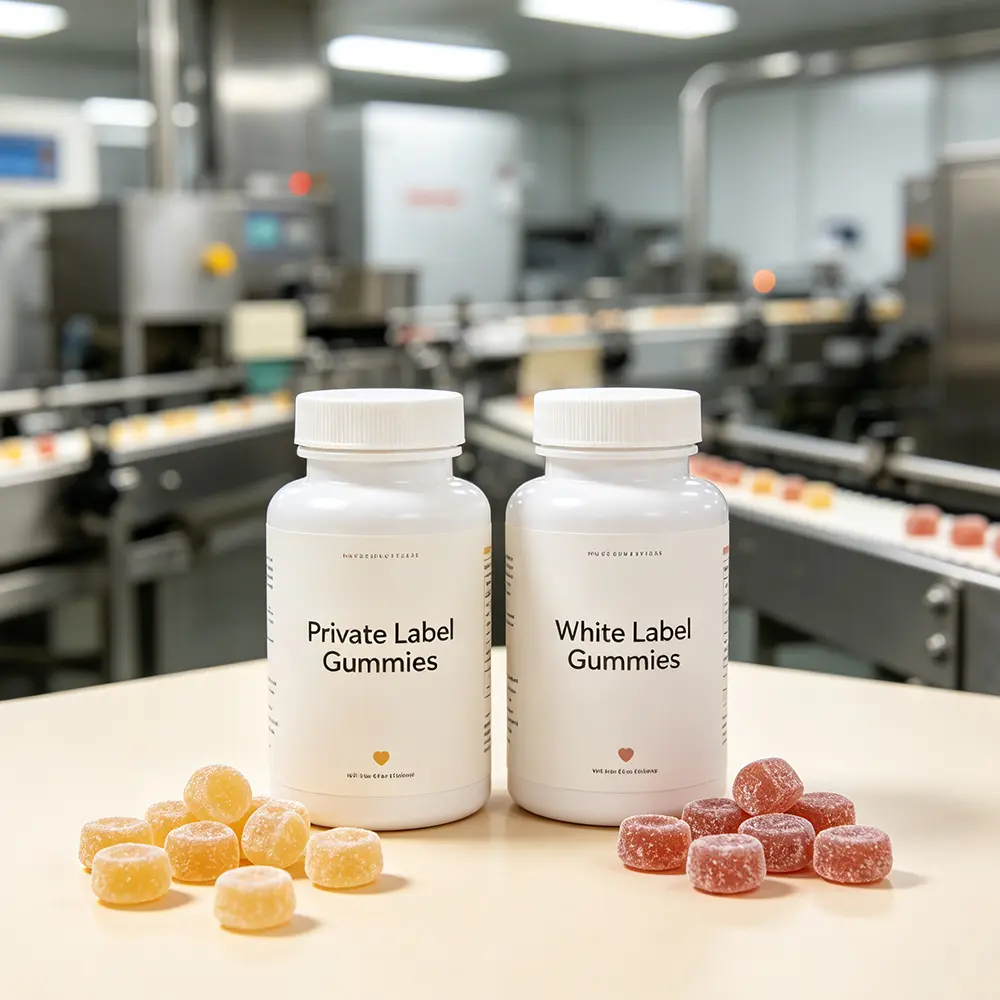
Private label gummy vitamins offer the fastest route to market. Stock formulas are already developed and tested; you customize flavor, shape, packaging, and labeling. This approach is ideal for brands testing new categories, seasonal launches, or SKUs where differentiation comes from branding and marketing rather than unique formulation. Custom formulations take longer but give you a unique product that competitors can’t copy — critical for brands building long-term equity in specific ingredient positions or delivery innovations.
Conclusion
Making gummy vitamins that deliver on their promises is a heat-and-moisture management problem that requires formulation expertise, process discipline, and rigorous stability testing. The market opportunity is substantial — USD 47.80 billion by 2030 — but the technical barriers are real and often underestimated by new entrants.
The brands that succeed in this space share three characteristics: they invest in formulation and stability upfront rather than treating it as an afterthought, they select manufacturing partners based on technical capability and track record rather than lowest price, and they build quality into every stage from ingredient sourcing through finished product testing. Skipping any of these steps creates risk that compounds through the product lifecycle — from first stability failure to regulatory action to brand damage.
For brands ready to enter the gummy segment, the path forward is clear: start with a clear product strategy, select your actives and gelling system deliberately, pilot before scaling, and partner with a manufacturer that has the R&D depth and quality systems to support your growth. The format rewards brands that get the science right — and punishes those that treat it like candy.
FAQ
What’s the typical lead time for custom gummy vitamin production?
Custom formulations with stability testing typically take 8–20 weeks from concept to finished goods. This includes 2–4 weeks of formulation development, 4–8 weeks of pilot production and initial stability, and 2–4 weeks of full-scale production and packaging. Stock formulas with confirmed artwork can ship in 2–3 weeks.
What’s the minimum order quantity for private label gummy vitamins?
MOQ varies widely by manufacturer and product complexity. Stock formulas may start at 1,000–2,000 units; custom formulations typically start at 5,000 bottles per SKU. Some manufacturers offer lower MOQs for startups or first-time customers as a way to build long-term relationships.
Can all vitamins and minerals be added to gummies?
No. Heat-labile nutrients like vitamin C, B vitamins, probiotics, and certain enzymes require encapsulation or other protection strategies to survive processing. Mineral forms also vary in stability and bioavailability — oxide forms are stable but poorly absorbed, while chelated forms (bisglycinate, picolinate) absorb better but may interact with the gel matrix. Your manufacturer should recommend appropriate forms based on their process parameters and your target dose levels.
How long do gummy vitamins last on the shelf?
Gummy supplements typically have a shelf life of 1–2 years at normal storage conditions (20–25°C, 50–60% RH). Capsules and tablets stored under the same conditions often stay stable for 3–5 years. The shorter shelf life reflects gummies’ higher moisture content and heat sensitivity. Proper packaging — desiccants, high-barrier films, nitrogen flushing — can extend shelf life by several months in challenging environments.
What certifications should a gummy vitamin manufacturer have?
At minimum: GMP (21 CFR Part 111 for US-market products), ISO22000 or FSSC 22000, and HACCP. Depending on your target markets, you may also need FDA facility registration, HALAL, KOSHER, Vegan, or BRC certifications. For brands selling on Amazon or through major retailers, additional third-party quality certifications (e.g., NSF, UL) may be required or provide competitive advantage.
How do I verify my gummy vitamins meet label claims?
Work with a manufacturer that conducts batch-level finished product testing and provides certificates of analysis (COAs) for every lot. Stability testing — both accelerated and real-time — validates that label claims hold through shelf life, not just at manufacture. FDA regulations require that supplements contain the labeled amount throughout shelf life, so your stability program is both a quality tool and a compliance requirement. For additional assurance, consider independent third-party testing on a periodic basis.
Cheney Chan|Technical Advisory Team,Nutrition Research Center,Focused on nutrition formulation research and quality standards, representing Gothink Biology, a dietary supplement manufacturer based in Shenzhen, China.This article is authored by Cheney Chan.
Shenzhen Gothink Biology Technology Co., Ltd. is a China-based nutrition supplement supplier offering OEM, ODM, CMO, and CDMO services. Our GMP-certified facility features a 100,000-class cleanroom with a daily output of 16 tons and an annual capacity of 5,000 tons. We hold certifications including ISO9001, ISO22000, HACCP, FDA, HALAL, GMP, KOSHER, BRC, FSSC 22000, PJPH, and Vegan. Our R&D team, led by scientists with postdoctoral experience at institutions including Cold Spring Harbor Laboratory and Emory University, supports custom formulation development across gummy, capsule, tablet, powder, liquid, and drop supplement categories.
For formulation consultation, stability testing quotes, or custom gummy development, visit au.gothinkbio.com or contact our technical team to discuss your project requirements.