
Part 1: Formulation and Ingredient Engineering
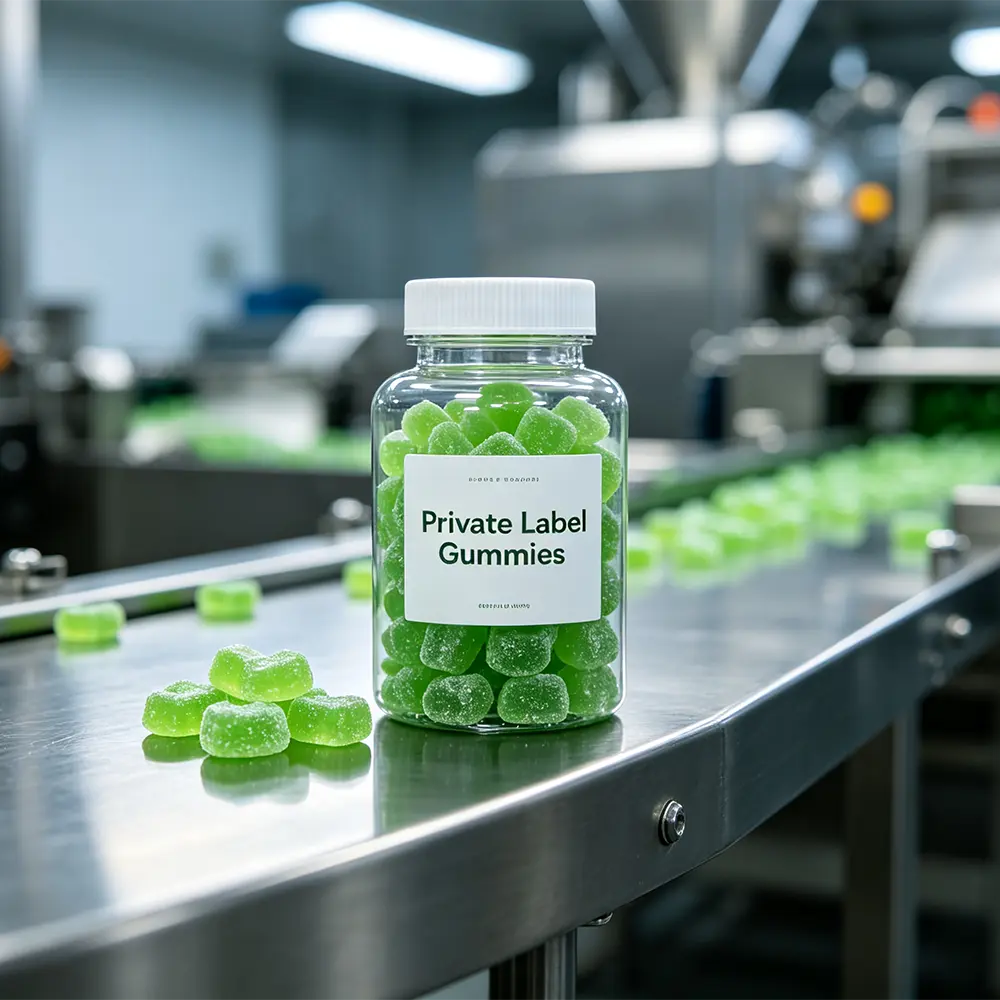
1. What exactly are Private Label Gummies?
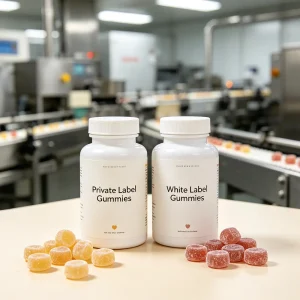
They are pre-validated gummy formulas manufactured under your brand name, label, and packaging. The manufacturer owns the base process and stability data, while you own the brand and market positioning. Flavor, color, sweetener, and active dosage can be adjusted within validated ranges without triggering a full re-development cycle.
2. How do private label gummies differ from custom formulation?
Private label uses an existing, stable chassis. Custom formulation builds a new chassis from raw materials, which requires compatibility trials, overage studies, and 3–6 months of stability data before you can even quote lead time. Private label is faster and lower-risk; custom is only necessary when your active ingredient, dosage, or dietary positioning has no precedent in the manufacturer’s portfolio.
3. What gelling systems are available?
Main systems are gelatin, high-methoxyl pectin, low-methoxyl pectin, carrageenan, and starchless blends. Pectin requires 55%+ soluble solids and pH 3.2–3.8 to form a brittle, heat-stable gel. Gelatin needs bloom 200–250 and sets by cooling, giving an elastic chew but poor heat stability above 35°C—a problem for summer shipping.
| System | Best For | Limitation | Process Note |
|---|---|---|---|
| High-Methoxyl Pectin | Vegan, Halal, Heat-Stable, Clean Label | Sensitive to pH, 3× cost vs gelatin | Precise acid dosing at 85–90°C |
| Gelatin (Bovine/Porcine) | Elastic chew, low cost, high clarity | Not vegan, melts in heat | Sets at 15–20°C in drying tunnel |
| Low-Methoxyl Pectin + Calcium | Low-sugar, sugar-free | Brittle texture if calcium too high | Requires calcium chloride metering |
4. Can you make vegan, sugar-free, halal, and kosher gummies?
Yes, but not with the same base. Vegan, halal, and kosher programs almost always require pectin. True sugar-free requires maltitol syrup and polydextrose to replace bulk, which reduces gel strength and demands polyol-tolerant pectin. Facilities that maintain HALAL, KOSHER, and Vegan certifications on the same line, with documented clearance between runs, are best positioned to support multi-market brands without revalidation costs.
5. Which ingredients do not work well in gummies?
High-dose minerals like calcium carbonate create chalky mouthfeel above 100 mg per piece. Free iron reacts with pectin and causes black spots and metallic taste. Probiotics lose viability if dosed above 60°C. Effervescent salts destroy gel structure by releasing CO₂ during setting. These are not “bad” ingredients—they just require pre-processing or alternative formats.
6. How do you handle oil-soluble actives like MCT, or omega-3?
Oil must be converted to a stable emulsion before cooking. Gum arabic and modified starch act as emulsifiers under high-shear homogenization to keep droplet size below 2 microns. Oil load above 15% of gummy weight weakens texture and causes oiling out during storage. That threshold is fixed by physics, not preference.
7. What causes sweating, sticking, and melting?
Three root causes: water activity (Aw) above 0.78, hygroscopic coating (citric acid + sugar sand), and insufficient drying. Pectin gummies need 24–48 hours in a dehumidified tunnel at 20–25°C and 30% RH to reach target Aw 0.60–0.75. Skipping this step to save time is the most common failure we see in factory audits of low-cost producers.
8. What is the typical dosage and active loading limit?
Most gummies weigh 2.5–4.0 g. Active load should stay under 20% of total weight to keep chew intact. For example, a 3 g apple pectin gummy can carry 300 mg apple cider vinegar or 100 mg ashwagandha easily, but 500 mg calcium requires a larger piece or a two-gummy serving size. Dosage feasibility is always a function of gummy mass.
9. How do you mask bitter or metallic notes?
Masking is a sequence, not a single flavor addition. First balance sweetener and acid to suppress basic bitter receptors, then add encapsulated flavors and bitterness blockers. Oil-based actives benefit from an additional wax coating. Over-flavoring without pH control actually amplifies bitterness—a mistake many first-time brands make by chasing sweetness alone.
10. What is overage and when is it needed?
Overage is extra active added to compensate for process loss and shelf-life degradation. Vitamin C, B12, and probiotics often need 10–30% overage based on accelerated stability data. Overage must stay within regulatory limits for daily value, so it requires a documented rationale that survives audit. Guessing at overage is a compliance risk, not just a quality risk.
Part 2: Manufacturing Process and Scale-Up
11. What is the standard production flow?
Weighing → gelling solution preparation → vacuum cooking to 75–82 Brix → cooling to 80–90°C → active and flavor dosing → depositor injection → curing and drying → demolding → sanding or oil coating → sorting → packaging. The active addition point is critical; heat-sensitive vitamins are dosed after cooking below 90°C to avoid potency loss.
12. What equipment differences affect texture?
Vacuum cookers prevent caramelization and produce lighter color than open kettles. Servo-driven Mogul depositors control weight variation within ±2%, while pneumatic systems drift to ±5%. Drying tunnels with humidity control deliver consistent Aw; room drying creates batch-to-batch hardness differences that customers notice immediately.
13. What is MOQ and why does it exist?
MOQ is typically 50,000–100,000 gummies per SKU for private label. Reasons are depositor minimum run time to stabilize temperature and pH, raw material pack sizes (pectin comes in 25 kg bags), and cleaning validation costs. Below MOQ, cost per unit spikes because setup and testing time remain unchanged whether you run 5,000 or 100,000 pieces.
14. What drives cost per gummy?
Actives account for 40–60% of cost, especially patented or trademarked forms. Pectin costs roughly three times gelatin and requires tighter sugar solids control. Testing, halal/kosher audits, and barrier packaging add 5–10%. Changing from 2 g to 3 g weight increases cost by about 25% due to raw materials and slower depositor output—a trade-off many brands underestimate.
| Cost Driver | Impact | Control Strategy |
|---|---|---|
| Active Form | High | Select generic vs trademarked, adjust dosage |
| Gelling Agent | Medium | Pectin for vegan/heat-stable, gelatin for cost |
| Drying Time | Medium | Automated tunnel vs manual rack |
| Packaging | Medium | Bottle vs pouch, desiccant, nitrogen flush |
15. What is the lead time from sample to bulk?
Lab sample: 7–10 days. Pilot sample with revised flavor: 10–15 days. Bulk after sample approval: 25–35 days including raw material procurement, production, drying, and QC release. Delays usually come from active COA failure or packaging material shortage, not production capacity itself.
16. How does scaling to 16 tons per day affect the formula?
Lab kettles heat evenly; production kettles have thermal gradients. Shear in pumps can break pectin chains if temperature drops below 75°C during transfer. On a 16 tons/day line, the formula must be adjusted for holding time, reduced mechanical agitation after acid addition, and texture validated with penetrometer rather than by hand. Scale-up is not linear—it is a separate engineering step.
17. What are common stability failures?
Syneresis (water leaking out), hardening due to starch retrogradation, and Maillard browning when whey protein meets reducing sugars. Color fading in natural anthocyanins is accelerated by high Aw and light exposure. Every failure maps to a specific process parameter that was not controlled, which is why stability protocols must track more than just potency.
18. How do you control water activity and pH?
Target Aw is 0.60–0.75 for microbial safety and soft chew. Target pH for high-methoxyl pectin is 3.2–3.8; below 3.0 gel becomes too firm and syneresis increases. Buffering with sodium citrate and measuring Aw with chilled-mirror instruments on every batch before release is non-negotiable for consistent texture.
19. What testing is required per batch?
Identity and potency of actives by HPLC, Aw, pH, Brix, and weight uniformity. Microbiology: total aerobic count, yeast and mold, E. coli, Salmonella, Staphylococcus aureus. Heavy metals and residual solvents if applicable. Texture and color are recorded as part of in-process control, not just final release testing.
20. What certifications should a manufacturer hold?
Minimum is GMP and ISO22000. For export, add FSSC 22000 or BRC, FDA facility registration, and HALAL, KOSHER, Vegan as needed. A 100,000-class cleanroom and 10,000-class R&D lab indicate real air handling and contamination control—not just certificates on the wall. Verify the certifications are current and audited annually.
21. What is the difference between starch mogul and starchless production?
Starch mogul deposits into starch molds, which are cheap and flexible but require starch drying and recycling, generating dust and potential cross-contact. Starchless uses silicone or metal molds, giving sharp shapes, better weight control, and cleaner labels, but mold cost is higher. Most modern pectin gummy lines use starchless for vegan claims and allergen control.
22. Can you do dual-layer or center-filled gummies under private label?
Yes, but it requires a two-nozzle depositor and careful viscosity matching between layers. If one layer sets faster, you get delamination. Center-filled requires an oil-barrier pectin wall around the fill to prevent migration. MOQ is higher due to longer setup and yield loss during the initial runs.
23. What packaging prevents moisture migration?
High-barrier PET bottles with induction seal and desiccant, or stand-up pouches with aluminum layer and resealable zipper. Nitrogen flushing reduces oxidation for omega-3 and carotenoids. Sugar-sanded gummies need anti-caking oil coating, otherwise sugar sand dissolves and creates a sticky surface that customers reject.
24. What is shelf life and how is it validated?
Typical shelf life is 18–24 months. Validation combines accelerated testing at 40°C/75% RH for 3–6 months and real-time at 25°C/60% RH. Potency, Aw, pH, texture hardness, and sensory are tracked at each pull point. A product without Aw drift data should not claim 24 months—that claim requires evidence.
25. Are sugar-free gummies harder to produce?
Yes. Maltitol syrup has lower solids and higher hygroscopicity, so gel strength drops. You need polydextrose or isomalto-oligosaccharide for body and low-methoxyl pectin with calcium for set. Sugar-free also triggers laxative warning requirements above 20 g polyols per day in EU and other markets—a labeling obligation many brands overlook.
Part 3: Business, Regulatory, and Partner Selection
26. How do you prevent cross-contamination for allergens?
Allergen mapping, dedicated production days, validated cleaning with ATP swabs, and air filtration in a 100,000-class cleanroom. True allergen-free claims need line clearance and testing for milk, soy, and gluten residues. Many brands miss gelatin source cross-contact when they switch from porcine to bovine without full line clearance.
27. What documentation is provided for regulatory filing?
COA per batch, TDS, allergen statement, MSDS, manufacturing process statement, stability summary, and ingredient origin certificates. For US, FDA facility registration and compliance with 21 CFR 111. For EU, FIC-compliant nutrition and additive status. Missing documentation at registration is a preventable delay that can push launch by months.
28. Can private label gummies be made for US, EU, and Middle East markets?
Yes, but formulas differ. US allows higher vitamin D3 overages; EU restricts novel food status and titanium dioxide, and requires precise sweetener labeling. Middle East requires HALAL certification and often restricts alcohol-based flavor carriers. One formula rarely fits all three without adjustment, so plan for regional variants early.
29. What are typical defects brands miss during QC?
Weight variation beyond ±5%, tails from poor demolding, air bubbles from incorrect depositor vacuum, and uneven oil coating. Inconsistent sugar sanding causes some pieces to clump. These are caught by inline checkweighers and visual sorting, not just lab testing on a small sample.
30. How do you evaluate a manufacturer beyond price?
Check in-house R&D depth, QC lab equipment, daily capacity plus backup capacity, and audit history. A technical team with advanced degrees in food science or biochemistry will solve compatibility issues faster than a sales-led factory. Ask to see deviation logs and CAPA records—if they won’t show them, that’s your answer.
31. What IP protection exists for my formula?
Private label formulas remain manufacturer property; your brand and label are yours. Custom developments should be covered by NDA and a manufacturing agreement stating formula code and exclusivity terms. Reputable factories store formulas by code, not by client name, in limited-access systems—that protects both parties.
32. Can I bring my own ingredients?
Possible if you provide full COA, pesticide and heavy metal reports, and identity testing. The manufacturer must still re-test and reserves the right to reject if particle size or solubility breaks the gel system. Customer-supplied ingredients often delay production due to failed identity, so budget extra time for testing.
33. What causes color fading?
Natural colors like anthocyanin and curcumin degrade with heat, light, and high pH. Copper and iron catalyze oxidation. Fixes include low-temperature dosing, pH buffering to 3.2–3.5, and opaque or UV-barrier packaging. Synthetic colors are more stable but conflict with clean-label positioning that most brands now prioritize.
34. What are the risks of low-cost manufacturers?
Common shortcuts: open-kettle cooking causing burnt notes, no vacuum, no Aw control, no overage calculation, and blending finished gummies from different batches to meet potency. The result is texture drift, potency failure at month 9, and customer complaints about melting in summer. Cost saved in production becomes cost spent in returns and destroyed brand equity.
35. What is the first step to start a private label project?
Define active, dosage per serving, target claim, dietary positioning (vegan, sugar-free, pectin vs gelatin), target retail price, and annual volume. Then request a feasibility assessment and sample from an existing chassis. Provide your packaging concept early, since bottle diameter affects gummy size and count—changing it later adds weeks.
Start Your Gummy Project with a Feasibility Review
If you are comparing private label gummy manufacturers, ask for a sample from the exact chassis you will scale—not a lab prototype. Evaluate thermal stability, texture after 6 months, and documentation quality before you commit. The right partner shortens your path from concept to compliant commercial batch.
Shenzhen Gothink Biotech Co., Ltd. offers OEM, ODM, CMO, and CDMO services. Our GMP-certified facility features a 100,000-class cleanroom with a daily output of 16 tons and an annual capacity of 5,000 tons. Certifications include ISO9001, ISO22000, HACCP, FDA, HALAL, GMP, KOSHER, BRC, FSSC 22000, PJPH, and Vegan. Our R&D team, led by scientists with postdoctoral experience at institutions including Cold Spring Harbor Laboratory and Emory University, supports custom development across gummy, capsule, tablet, powder, liquid, and drop formats.