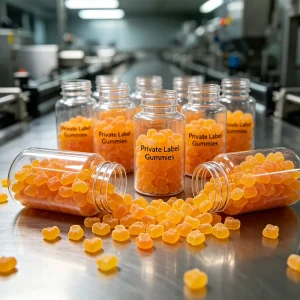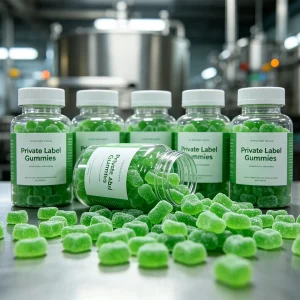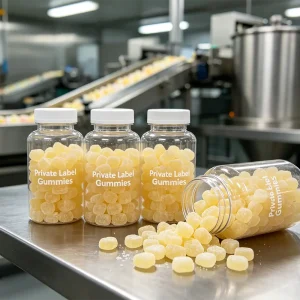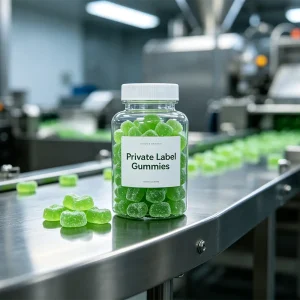

For most supplement brands, Private Label Gummy production looks straightforward on the surface: select a formula, put your label on it, and launch. In practice, the three variables that determine whether that launch stays on time and on budget are MOQ, lead times, and quality standards. They are not separate line items on a quotation. They are linked technical and commercial decisions that reflect how gummies are actually made.
A brand that understands this link can evaluate a Private Label Gummy Manufacturer more accurately, avoid late-stage changes, and lock in a product that is stable, compliant, and scalable. This article breaks down how those three variables work in real Gummy Contract Manufacturing.
What Private Label Means in Gummy Contract Manufacturing
Not all private label offers are equal. The level of customization directly affects MOQ, lead time, and QC requirements.
- Stock formula, private label: The factory owns a validated formula and process. You choose flavor, color, and packaging. MOQ is lowest because raw materials are already qualified and the process is fixed. Lead time is shortest.
- Semi-custom formula: You start from a stock base but change active dosage, add an ingredient, or switch sweetener system or pectin type. This triggers new compatibility checks, texture tuning, and often new raw material sourcing. MOQ rises because ingredient purchasing is no longer shared across multiple customers.
- Full custom private label: New actives, new dosage, new texture target. Requires lab development, pilot batch, and stability assessment. MOQ is driven by process batch size, not just packaging.
When a supplier quotes a low MOQ for a fully custom idea, ask what is fixed and what is not. Often the low MOQ only applies if you accept their existing gel system, flavor masking system, and packaging inventory.
MOQ in Private Label Gummy Production: What Drives the Number
MOQ is not a sales tactic. It reflects minimum viable production at each step of the chain. For gummies, three layers stack together.
1. Formula and Ingredient Layer
Active loading changes everything. A 50 mg vitamin C gummy has very different solids content than a 500 mg calcium + vitamin D3 pectin gummy. High-dose or hygroscopic actives increase total solids, affect pH, and change cooking loss. That affects yield and texture.
Ingredient sourcing also sets floors. Pectin grades, natural colors, or trademarked botanical extracts are often purchased with their own supplier MOQs. For example, a specific low-methoxyl pectin or a flavor masking system for zinc or ashwagandha may only be available in 25 kg lots. If your batch needs 5 kg, the manufacturer must absorb or amortize the rest. That cost shows up as a higher private label MOQ.
2. Process and Equipment Layer
Commercial gummy depositors run at a fixed throughput. The depositor, mogul, and drying room are designed around batch size, not bottle count. A typical production batch may be defined by cooking kettle volume, for example, one cook equals X kg of slurry, which yields Y thousand gummies at a given piece weight.
You cannot economically run a 20% batch because heating, depositing, and starch handling behave differently at partial loads. Texture consistency suffers, and scrap rate rises. For pectin gummies, which require precise Brix and pH control, running below the validated batch size can cause incomplete gelation or variation in water activity.
Drying and conditioning is the other constraint. Gummies are dried on trays for 24 to 72 hours to reach target water activity. A half-filled drying room wastes energy and blocks scheduling for other orders. So the factory defines a minimum number of trays per run.
3. Packaging Layer
Often the highest MOQ comes from packaging, not gummies. Printed stand-up pouches typically have plate charges and MOQs of several thousand units. Custom printed bottles and caps have similar thresholds. Even stock bottles become an MOQ issue if you require a specific color, child-resistant closure, or desiccant liner.
For this reason, a manufacturer may quote two MOQs: a gummy bulk MOQ and a finished pack MOQ. If you plan to start small, ask if they offer neutral stock packaging with a pressure-sensitive label for the first run, then switch to custom printed packaging after market validation.
Lead Times: The Real Timeline From PO to Finished Goods
Buyers often ask for production time alone. What matters is total lead time from artwork and formula lock to ex-factory goods. In commercial practice, it has six phases.
| Phase | What Happens | What Can Extend It |
|---|---|---|
| 1. Formula and Spec Lock | Final active dosage, gel system, flavor, piece weight, and analytical specs confirmed. Sample approval. | Late changes to actives, sweetener, or natural color. pH or texture fails at pilot. |
| 2. Raw Material Procurement | Sourcing actives, pectin/gelatin, flavors, packaging components. Incoming QC. | Trademarked ingredients, new botanical extracts, custom packaging, import lead time for colors. |
| 3. Production Scheduling | Slot in depositor and drying room. Line clearance and batch record preparation. | Peak season capacity, flavor allergen cleaning sequence, shared line with other pectin runs. |
| 4. Manufacturing and Drying | Cooking, depositing, starch molding or silicone molding, drying, sugar sanding or oil coating. | High-dose or high-moisture formula requiring longer drying to reach target water activity. |
| 5. QC Release | Weight check, texture, assay for actives, microbial, water activity, visual inspection. | Active assay retest, microbial hold, documentation review for export markets. |
| 6. Packaging and Export Prep | Bottling or pouch filling, sealing, labeling, carton packing, COA and export docs. | Child-resistant packaging testing, label proof delays, third-party lab certificate wait. |
For a stock private label gummy with in-stock raw materials and standard bottles, total lead time can be relatively short. For a semi-custom pectin formula with new actives and custom pouches, procurement and pilot work will dominate. An illustrative example: raw material procurement alone can account for 40 to 60 percent of total lead time when a botanical extract or custom pouch film is involved.
Why MOQ and Lead Time Are Linked
A decision to reduce MOQ often increases lead time, and a decision to shorten lead time often increases MOQ. Here is why.
If you want a lower MOQ, the factory may need to aggregate your order with others using the same gel system and drying profile. Your job waits for a compatible production window. If you want a fast turnaround, the factory may require you to meet a full batch and full packaging lot so they can run you standalone without waiting.
Formulation choice amplifies this. A high-solids formula with multiple actives reduces depositing speed and increases drying time to hit water activity below 0.75. That reduces daily output, so fewer batches fit in a week. Your lead time extends unless you commit to a larger order that justifies a dedicated drying room cycle.
Quality Standards You Should Lock Down Before Production
Quality in private label gummy is not just a finished product COA. It is a set of specifications agreed before manufacturing begins. In Gummy Contract Manufacturing, gaps here cause most disputes after delivery.
Focus on these control points:
| Control Area | What to Specify | Why It Matters Commercially |
|---|---|---|
| Raw Material Spec | Active form and potency, pectin grade and bloom, carrier for flavor, country of origin if required. | Different pectin grades change texture and release. A cheaper mineral form may have lower bioavailability and higher flavor impact. |
| Gel System and Texture | Target piece weight, hardness, chewiness, Brix, pH range, water activity target. | Texture determines consumer acceptance and also moisture migration and shelf life. Gelatin and pectin behave differently during summer transit. |
| Active Uniformity | Content per gummy, weight variation limit, assay method, overage policy if applicable. | High-dose minerals and low-solubility botanicals can settle. Depositing without proper mixing creates batch-to-batch variation. |
| Microbial and Chemical Safety | Total plate count, yeast and mold, heavy metals, residual solvents for extracts. | Gummy water activity must be controlled to prevent yeast and mold growth during shelf life. |
| Packaging Barrier | Bottle moisture barrier, seal integrity, desiccant use, pouch film oxygen and moisture transmission rate. | Packaging is part of stability strategy. Poor barrier leads to hardening or active degradation. |
| Documentation | COA template, batch record, allergen statement, GMP certificate, manufacturing flow chart. | Import markets often require specific documentation. Missing paperwork delays customs more than production. |
Ask for water activity, not just moisture content. Water activity predicts microbial risk and texture change better than total water. For pectin gummies, typical commercial targets are below 0.75 to 0.80, depending on formula and packaging. Also ask how the factory handles active retention during cooking. Heat-sensitive vitamins like vitamin C or probiotics require low-temperature addition and validated holding times. A lab sample that shows good assay may lose potency at commercial scale if addition point is not controlled.
How to Evaluate a Private Label Gummy Manufacturer on MOQ, Lead Time, and Quality
Use the same set of questions across suppliers so you compare like-for-like.
- MOQ definition: Is MOQ defined per SKU, per flavor, per batch, or per packaging lot? What is the bulk gummy MOQ versus finished pack MOQ?
- Batch size validation: What is your standard cooking kettle size and drying tray capacity? Can you run a reduced batch without texture loss?
- Ingredient ownership: Which raw materials are stock and which require new purchase? What are their supplier MOQs and lead times?
- Pilot capability: Do you run a pilot batch before commercial production for semi-custom formulas? What is the cost and timeline?
- Lead time breakdown: Provide procurement time, production time, QC release time, and packaging time separately, not just a single number.
- Quality agreement: Do you provide a written spec sheet covering piece weight, Brix, pH, water activity, texture, assay range, and microbial limits? Is overage applied, and if so, how is it justified?
- Scale-up record: What happens if texture or assay fails at scale? Who bears the cost of rework?
- Stability data: Do you have accelerated stability on this gel system and packaging combination?
A credible manufacturer will explain why a request increases MOQ or lead time instead of simply saying yes. That explanation usually reveals their process understanding.
Common Cost Traps When Comparing Private Label Quotes
Unit price alone can mislead. Three patterns create higher total project cost despite a lower per-bottle quote.
1. Low gummy price, high packaging MOQ. The factory quotes an attractive gummy price but requires 10k custom pouches. Your inventory cost shifts from gummies to packaging.
2. Low MOQ, no pilot. Skipping pilot saves money upfront but increases risk of texture or assay failure at scale. Rework, reselection of flavor masking, or new drying parameters late in the project costs more than a pilot batch.
3. Unspecified QC limits. A quote that does not define water activity, weight variation, or assay tolerance leaves room for wide batch variation. Consistency suffers, and consumer complaints rise after summer storage.
When comparing quotes, ask each supplier to break out raw material cost, production cost, QC and documentation cost, packaging cost, and yield assumption. Differences in yield assumption alone can explain a 5 to 10 percent price gap for high-dose formulas.
Putting It Together: A Decision Framework
Before requesting a final quotation for private label gummy, lock these five items:
- Exact active form, dosage per gummy, and whether the formula is stock, semi-custom, or full custom.
- Gel system preference and why. Pectin is vegan and stable at higher temperatures, gelatin gives elasticity but has halal/kosher considerations.
- Piece weight and count per bottle or pouch. This determines total solids and cost per serving.
- Packaging format and target barrier. Bottle with induction seal and desiccant versus high-barrier pouch.
- Target market documentation. US, EU, UK, or Middle East requirements change label and testing needs.
Once these are fixed, MOQ, lead time, and quality specs become calculable rather than negotiable. The manufacturer can then give you a realistic batch size, a procurement timeline based on actual ingredient lead times, and a QC plan that matches your market.
FAQ
What is a typical MOQ for private label gummy?
There is no single industry MOQ because it depends on batch size, actives, and packaging. For stock formulas with standard bottles, bulk MOQ may be driven by one cooking batch. For custom pectin formulas or custom printed pouches, packaging MOQ often exceeds gummy MOQ. Ask for both numbers separately.
How long does private label gummy production really take?
Total lead time includes formula lock, raw material procurement, scheduling, manufacturing and drying, QC release, and packaging. Procurement of trademarked ingredients or custom packaging is usually the longest phase. Production itself, including drying to target water activity, typically takes days, not weeks, but QC release and documentation add time.
Can I reduce MOQ by using stock packaging?
Yes, in many cases. Using the manufacturer’s stock bottle, cap, and neutral pouch with a pressure-sensitive label removes custom packaging MOQ. This is a common path for a first market test before moving to custom printed packaging.
What quality documents should I request from a Private Label Gummy Manufacturer?
Request a detailed finished product specification, raw material specifications for actives and pectin/gelatin, COA template, water activity and microbial limits, assay method, allergen and GMO status, and GMP and relevant certification copies. For export, also request manufacturing flow chart and stability summary if available.
Why does the same gummy formula cost different at different factories?
Differences come from batch size, yield assumption, pectin grade, active form, flavor masking system, drying time required to reach target water activity, QC testing scope, and packaging barrier. A lower unit price may reflect a larger assumed yield or a less stringent texture and assay tolerance.
Jack Luo|Senior Technical Advisor, Nutrition Research Center Representing Gothink Biology.
[Shenzhen Gothink Biotech Co., Ltd. is a China-based nutrition supplement supplier offering OEM, ODM, CMO, and CDMO services. Our GMP-certified facility features a 100,000-class cleanroom with a daily output of 16 tons and an annual capacity of 5,000 tons. We hold certifications including ISO9001, ISO22000, HACCP, FDA, HALAL, GMP, KOSHER, BRC, FSSC 22000, PJPH, and Vegan. Our R&D team, led by scientists with postdoctoral experience at institutions including Cold Spring Harbor Laboratory and Emory University, supports custom formulation development across gummy, capsule, tablet, powder, liquid, and drop supplement categories.]